- This white paper demonstrates how the MaxLinear MxL86252C Ethernet switch SDK is successfully incorporated into the RUCKUS® H670 Indoor AP platform and outlines the resulting design considerations and benefits.
Authors
| Jagdish Kaushik Senior Principal Application Engineer, MaxLinear Inc. |
Shashikant Rao Principal Software Engineer, RUCKUS® Networks |
Executive Summary
This white paper presents real‑world insights from integrating the MaxLinear MxL86252C Ethernet switch software development kit (SDK) into the RUCKUS® H670 Indoor Access Point (AP) platform, highlighting the practical challenges of incorporating modern switch silicon into an open, Linux®‑based system. It examines alignment with Linux Distributed Switch Architecture (DSA), adapting to OpenWrt®’s evolving network stack, and leveraging Ethernet switch software box (ethswbox) for low-level SDK and hardware visibility, debugging, and configuration. Its objective is to provide system architects, silicon vendors, and ecosystem partners with actionable lessons learned from silicon‑to‑system integration in a production networking platform.
Introduction
The RUCKUS H670 Indoor Access Point is a high-performance networking platform designed for enterprise and carrier-grade Wi-Fi deployments.
RUCKUS H670 Indoor AP Platform Key Specifications
- Wi-Fi 7 Ready: Delivers ultra-fast wireless speeds and low latency, ideal for high-density denvironments and bandwidth-intensive applications.
- Dual Concurrent IoT Radios: Enables seamless integration with IoT devices such as smart locks, sensors, and room controls.
- Multi-Gigabit Power over Ethernet (PoE) Ports: Offers dual multi-gigabit PoE ports for high-speed wired connectivity and device power delivery.
- Wall-Mounted Form Factor: Designed for discreet deployment in hotel rooms, dormitories, office environments, classrooms, retail outlets, and multi-dwelling units (MDUs).
- Hospitality Focus: Tailored for premium hotel environments, supporting smart-room technologies and enhanced guest experiences.
MaxLinear MxL86252C switch is a 2.5G Ethernet switch with advanced PHY capabilities, targeting multi-gigabit applications. It is a highly integrated 7-port Ethernet switch designed for multi-gigabit applications, particularly in enterprise, industrial, and carrier-grade networking. The MxL86252C aligns well with the H670 Indoor AP use case, providing the multi-gigabit switching capabilities required for multi-gigabit access points and hospitality edge deployments.
MxL86252C Key Specifications
- Ports
- 5 × 2.5GBASE-T PHYs (supporting 10/100/1000/2500Mbps)
- 2 × 10G SerDes uplinks (XFI, USXGMII, SGMII+ interfaces)
- PHY Capabilities
- Supports 2.5GBASE-T over standard Cat5e/Cat6/Cat7 cabling
- Backward compatible with 1000BASE-T, 100BASE-TX, and 10BASE-Te
- Advanced Features
- IEEE 1588v2 and SyncE for precise time synchronization
- Supports Energy Efficient Ethernet (EEE)
- Low power consumption due to high integration
- Package
- Compact 12mm × 12mm BGA-277 form factor
- Software Support
- DSA driver/Host API available via MaxLinear GitHub
- Managed and unmanaged configuration options
Integration Architecture
The integration architecture enables seamless incorporation of the MaxLinear MxL86252C SDK into the RUCKUS H670 Indoor AP's OpenWrt-based Linux environment using the Linux DSA framework.
The primary objectives of the integration are to:
- Enable full switch functionality through the Linux DSA framework.
- Ensure compatibility with OpenWrt’s networking stack.
- Leverage the MxL86252C’s advanced PHY features including 2.5GBASE-T, SyncE, and IEEE 1588v2.
System Overview
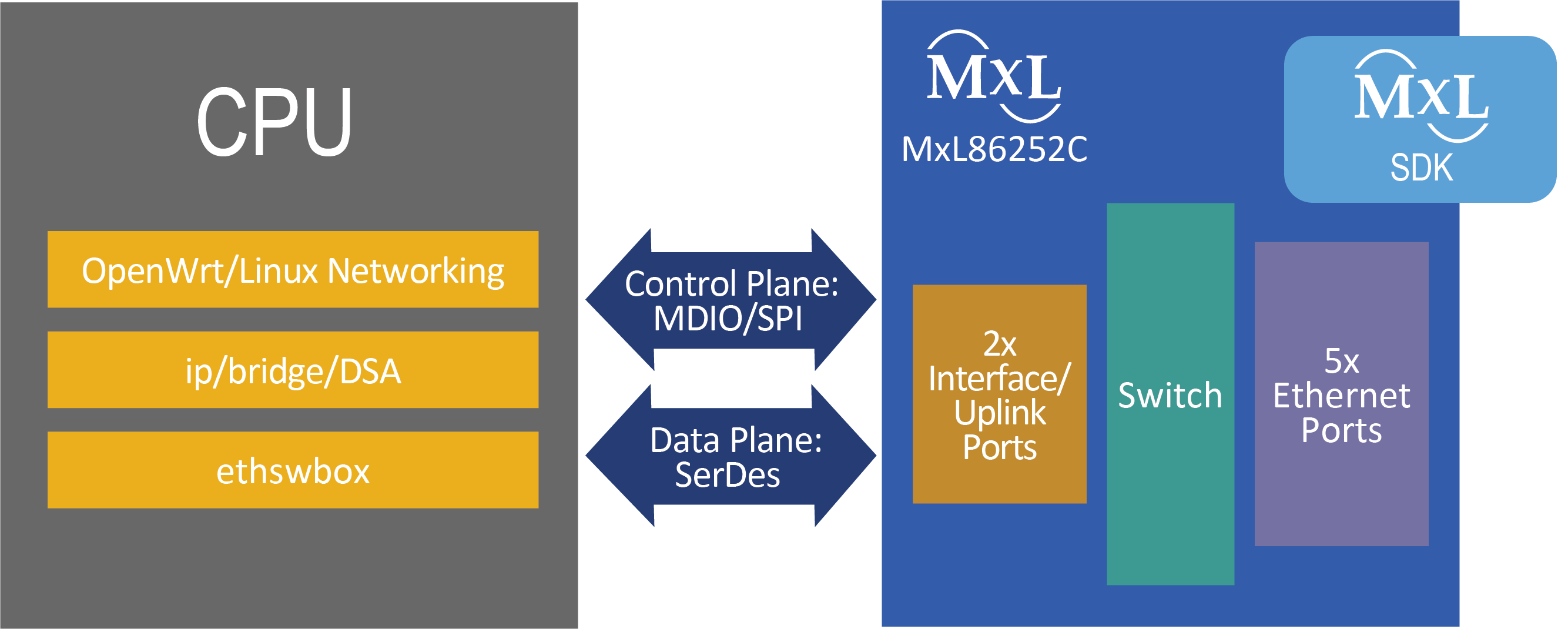
- CPU ↔ MxL86252C through the MDIO/SPI
- OpenWrt OS with Linux 5.x kernel
- DSA framework for switch abstraction
- ethswbox CLI for direct switch access
Software Stack
- Linux kernel (DSA)
- OpenWrt network stack
- MaxLinear SDK (proprietary APIs)
- Userland tools (ip, bridge, ethswbox)
DSA Compatibility
The SDK remains authoritative for hardware configuration and state, while DSA is the authoritative source for Linux network device (netdev) state.
- Issue: The MxL86252C SDK is not natively DSA-compliant.
- Impact: Requires wrapper drivers or kernel module adaptations.
- Solution: Develop a DSA-compatible driver layer that maps the SDK APIs to the DSA operations (for example, port_enable and port_vlan_add).
OpenWrt VLAN and Bridge Management
- Issue: OpenWrt uses bridge-vlan syntax, which must align with SDK VLAN tables.
- Impact: Mismatches can cause traffic loss or misrouting.
- Solution: Synchronize VLAN configuration between OpenWrt and the SDK using a middleware script or daemon.
Key Integration Challenges
PHY Link Status Handling
- Issue: Per-port polling via Linux work queues is inefficient.
- Impact: High CPU usage and delayed status updates.
- Solution: Implement a bulk status API in the SDK and modify the DSA driver’s adjust_link() function to use this API.
Boot-Time Initialization
- Issue: Timing mismatches between SDK initialization and the Linux network stack.
- Impact: Ports may not be ready when the bridge is created.
- Solution: Use the systemd service dependencies to ensure the expected sequencing.
Debugging with ethswbox
- Issue: Limited visibility into the SDK internals via standard Linux tools
- Solution: Use ethswbox for:
- Port status—ethswbox port status
- VLANs—ethswbox vlan show
- Registers—ethswbox reg read <page> <offset>
- Port stats—ethswbox port stats
SA Driver Integration and System Enablement for MxL86252C
The MxL86252C switch is integrated into Linux using the DSA framework, which provides a standardized and upstream-aligned method for representing Ethernet switches as first-class networking devices in the Linux kernel. The MxL862xx DSA driver is implemented as a native kernel driver integrated directly into the kernel source tree and build system. It enables full compatibility with Linux networking subsystems and OpenWrt’s DSA-based configuration model. This approach replaces legacy switch abstractions with a unified, kernel-managed architecture, simplifying long-term maintenance while aligning with modern Linux networking practices.
Kernel Integration Architecture
The MxL862xx DSA driver is integrated under the standard Linux DSA directory structure (drivers/net/dsa/) alongside existing upstream switch drivers. The integration follows established kernel conventions, which include:
- Registration through Kbuild (Makefile) and Kconfig
- Support for custom DSA tagging protocols
- Binding through device tree descriptions
- Static kernel integration requiring a full kernel rebuild
The existing lantiq_gswip driver serves as a practical reference point for integration patterns, configuration placement, and tag driver registration.
DSA Driver Architecture for MxL86252C
PHY Driver Considerations
For optimal operation—particularly for 2.5GBASE-T support—the MaxLinear GPHY driver is strongly recommended. While the generic Linux PHY driver provides basic 10/100/1000 support, it does not expose the full capabilities of the internal PHYs used in the MxL862xx family.
Although the MaxLinear GPHY driver is upstream as of Linux v5.15, MxL862xx support requires an updated driver package (v1.2.0.0) to be manually integrated into the kernel source tree. This ensures accurate PHY representation, proper link-status reporting, and full rate support.
DSA Tagging Support
The MxL86252C integration introduces two switch-specific DSA tagging modes:
- MxL862 (8-byte proprietary tag)
- MxL862_8021Q (4-byte VLAN-based tag)
These tagging protocols are registered within the kernel’s DSA tag framework and assigned unique protocol identifiers. Tag selection is performed via the device tree on the CPU port using the dsa-tag-protocol property, allowing flexible deployment without driver modifications.
Device Tree Integration
The switch is described in the device tree as an MDIO-attached device, with each physical port represented as a DSA port node.
Internal PHYs are enumerated through a nested MDIO bus, while the CPU port defines the following:
- Interface mode (for example, USXGMII)
- Fixed-link parameters
- Selected DSA tagging protocol
This structure allows Linux to auto-instantiate switch ports as standard network interfaces (lanX) while maintaining a clear hardware-to-software mapping.
Build and Verification
Because the DSA driver is statically linked, a kernel rebuilding is required following integration. Successful integration is verified by:
- The presence of compiled DSA and tagging objects in the kernel tree
- Registration of the switch driver on the MDIO bus>
- Exposure of tagging protocol information via sysfs
- Recognition of switch ports as DSA interfaces
These checks confirm correct kernel registration, MDIO binding, and DSA framework operation.
Migration from swconfig to DSA
The OpenWrt uses DSA as the default switch configuration framework, replacing the legacy swconfig model. Under DSA, switch ports participate directly in Linux networking constructs (bridges, VLANs, interfaces), enabling a cleaner and more expressive configuration model.
VLAN configuration is performed using standard OpenWrt abstractions such as bridge-vlan, making the switch behavior transparent to higher-level networking services.
SDK and DSA VLAN Synchronization
The MxL86252C SDK maintains an internal VLAN table independent of Linux. To prevent configuration mismatches between the SDK and the kernel:
- A synchronization daemon can monitor OpenWrt network configuration and apply changes through SDK APIs; or
- The DSA driver itself can be extended to invoke SDK VLAN functions directly.
Both approaches ensure consistency between Linux’s logical network view and the switch hardware configuration.
Boot-Time Sequencing Challenges
During system boot, Linux bridge creation may occur before the switch hardware is fully initialized, leading to transient misconfiguration.
This issue is addressed by enforcing explicit service dependencies, ensuring that switch initialization completes before bridge creation.
Additional validation can be performed by querying switch port readiness through ethswbox before enabling network services.
Low-Level Diagnostics with ethswbox
The ethswbox CLI provides direct visibility into the switch SDK and hardware state and plays a critical role during integration and validation.
It can be used to:
- Inspect per-port link status and counters
- Examine VLAN tables
- Read and verify switch registers
- Cross-validate SDK state against DSA-managed configuration
Example workflow: After boot → verify ports → verify VLANs → validate counters.
Ethswbox is also well suited for automation, enabling scripted post-boot verification and regression testing to ensure consistency between kernel, SDK, and hardware.
Best Practices and Recommendations
- Use DSA for runtime configuration. Reserve ethswbox for diagnostics.
- Maintain a configuration synchronization layer between OpenWrt and the SDK.
- Contribute DSA driver patches upstream for long-term maintainability.
- Collaborate with MaxLinear for SDK enhancements (bulk APIs and interrupt support).
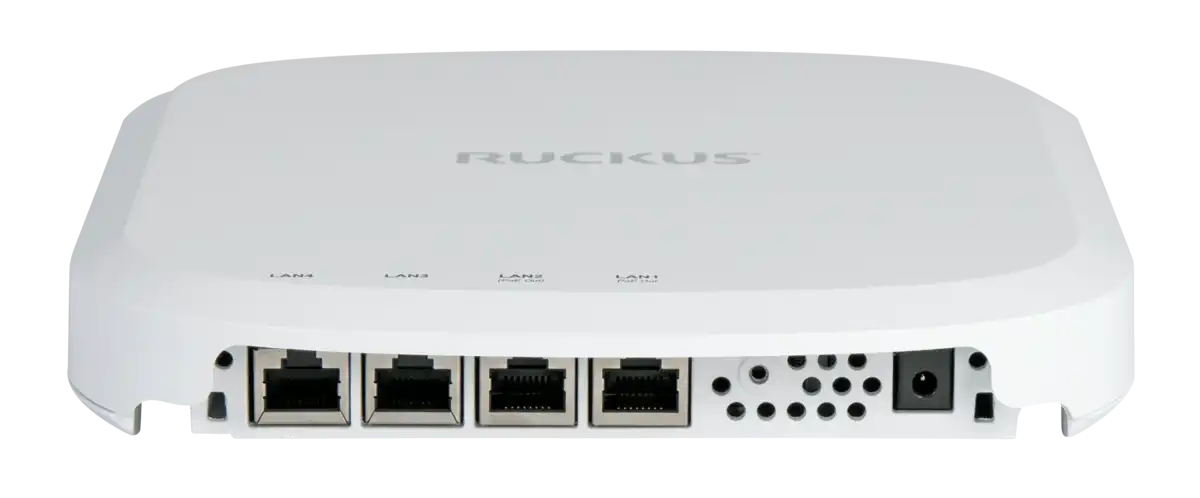
Figure 2: RUCKUS H670 Indoor Access Point
Conclusions
Integrating the MaxLinear MxL86252C switch SDK with the RUCKUS H670 Indoor AP platform under OpenWrt highlights both the technical rigor and the strategic value of adopting a Linux‑native, DSA‑based Ethernet architecture. While the integration introduces challenges related to driver alignment, boot sequencing, SDK synchronization, and PHY management, these are effectively mitigated by leveraging Linux Distributed Switch Architecture (DSA) and proven diagnostic tools such as ethswbox.
From a system and business perspective, this integration delivers significant long‑term advantages. By aligning the switch architecture with upstream Linux frameworks, the solution reduces technical debt, minimizes platform‑specific customization, and simplifies ongoing maintenance. This directly lowers development and sustainment costs while accelerating time‑to‑market for new products and features.
The DSA‑centric approach also enables faster roll‑out across multiple platforms and customer deployments. Once integrated, the same architectural model can be reused across hardware variants and product lines with minimal incremental effort, making it particularly attractive for OEMs and ODMs serving diverse customer requirements. Customers benefit from consistent behavior, predictable configuration models, and seamless integration with standard Linux and OpenWrt networking constructs.
For end customers and ecosystem partners, including PHY vendors, magnetics suppliers, and Open Systems Alliance participants, this design provides clear hardware abstraction, improved interoperability, and enhanced observability. Developers can rely on standardized Linux tools while retaining access to low-level SDK and silicon capabilities when required. This dual-layer visibility significantly improves debugging efficiency, field troubleshooting, and production validation.
Ultimately, the MxL86252C integration on the RUCKUS H670 Indoor AP demonstrates how modern Ethernet platforms can successfully bridge silicon innovation and open software ecosystems. By combining DSA alignment, OpenWrt compatibility, and robust SDK tooling, the solution enables scalable, production-ready Ethernet systems that are easier to deploy, maintain, and adapt to evolving customer requirements across enterprise, service provider, and open networking markets.
References
- https://www.maxlinear.com/product/interface/ethernet/ethernet-switches/mxl86252c
- https://www.ruckusnetworks.com/products/wireless-access-points/h670