Protected RS-485 / RS-422 Connectivity from 250kbps to 50Mbps
The MxL8321x family provides three data-rate options for half-duplex RS-485 / RS-422 communication: 250kbps, 500kbps, and 50Mbps. Designed for industrial systems exposed to electrical noise and transient events, the family combines a 3.0V to 5.5V supply range, ±15V operational common-mode range, integrated IEC electrostatic discharge (ESD) and electrical fast transient (EFT) protection, and support for up to 256 transceivers on a bus.
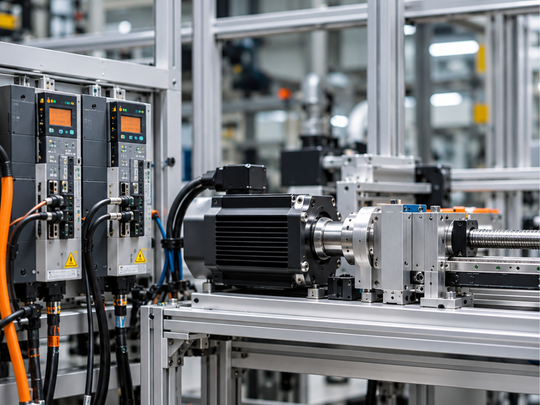
Match the Transceiver to the Data Rate, Cable, and EMI Requirements
The MxL8321x family gives designers a scalable set of half-duplex RS-485 / RS-422 transceivers for electrically harsh industrial systems. Slew-rate-limited MxL83211 (250kbps) and MxL83212 (500kbps) devices minimize EMI and reflections on long or imperfectly terminated cables, while the MxL83214 supports 50Mbps with driver propagation delay of 18 ns maximum and differential skew of 3.5 ns maximum.
The bus pins withstand ±4kV IEC 61000-4-4 EFT, ±12kV IEC 61000-4-2 contact ESD, ±16kV IEC air-gap ESD, and ±15kV HBM ESD. This integrated protection helps equipment meet IEC system-level requirements with fewer external TVS diodes. An extended ±15V operational common-mode range, enhanced receiver fail-safe, glitch-free hot-plug inputs, and a 1/8 unit-load receiver keep multidrop networks reliable in the presence of motor, inverter, and relay noise.
With 1.5mA maximum supply current, a 0.1 µA typical shutdown mode, and 3 mm × 3 mm MSOP-8 and VSON-8 options, the MxL8321x family suits space-constrained and power-sensitive designs from motor drives and encoders to building automation and telecom equipment.
- Maintain interoperability across RS-485 networks with electrical characteristics that meet or exceed TIA/EIA-485A requirements.
- Select the required data rate across one footprint: 250kbps, 500kbps, and 50Mbps options share one pinout, so one layout covers slow field buses and fast encoder links.
- Close tight timing budgets at 50Mbps: MxL83214 driver propagation delay is 18 ns max with 3.5 ns max differential skew over temperature and supply.
- Run long, imperfect cables quietly: slew-limited MxL83211 and MxL83212 drivers cut radiated emissions and ringing on stubs and mismatched terminations.
- Ride through ground shifts and inverter noise: a ±15V operational common-mode range, receiver input filtering, and 30 mV receiver hysteresis keep data valid between distant nodes.
- Scale the network without repeaters: a 96 kΩ, 1/8 unit-load receiver lets up to 256 nodes share one bus.
- Skip external bias resistors: enhanced fail-safe forces RO high on open, shorted, or idle terminated lines with a 50 mV minimum margin.
- Plug into a live backplane: every device holds DE low and RE high for about 10 µs at power-up, so inserting a card does not corrupt bus traffic.
- Stretch the power budget: 1.5mA max supply current and 0.1 µA typical shutdown current suit battery-backed meters and always-on sensors.
- Survive wiring faults and bus contention: ±250mA driver current limiting and a 170°C thermal shutdown place outputs in high impedance until the fault clears.
- Fit dense boards: MxL83212 and MxL83214 come in 3 mm × 3 mm MSOP-8 and VSON-8, the VSON-8 at 0.9 mm height.
- Design once for 3.3V or 5V systems: a 3.0V to 5.5V supply, -40°C to +125°C rating, and >2.1V PROFIBUS-compatible output at 5V.
The three MxL8321x devices use different driver characteristics to address different serial-link requirements. Cable length and data rate should be evaluated together. RS-485 / RS-422 links can extend to approximately 1200 m at low data rates, while higher data rates require shorter cable lengths. The actual limit depends on cable characteristics, termination, topology, and acceptable signal margin.
|
MxL83211
High Performance RS-485 Transceiver with Extended IEC ESD and EFT
Active

|
0.25 | NSOIC8 | MXL83211E-ADA-EVK-1 | Buy Now | Order Samples | MxL83211 datasheet | High Performance RS-485 Transceiver with Extended IEC ESD and EFT | RS-422, RS-485 | 3.3, 5 | 1 | 1 | Half | 4 | 15 | 12 | Advanced | 256 | - | - | -40 to 125 | - | - | - | 1.5 | ✔ | 0.1 | ✔ | ✔ | |
|
MxL83212
High Performance RS-485 Transceiver with Extended IEC ESD and EFT
Active

|
0.5 | NSOIC-8, MSOP-8, VSON-8 | MXL83212E-ADA-EVK-1 | Buy Now | Order Samples | MxL83212 datasheet | High Performance RS-485 Transceiver with Extended IEC ESD and EFT | RS-422, RS-485 | 3.3, 5 | 1 | 1 | Half | 4 | 15 | 12 | Advanced | 256 | - | - | -40 to 125 | - | - | - | 1.5 | ✔ | 0.1 | ✔ | ✔ | |
|
MxL83214
High Performance RS-485 Transceiver with Extended IEC ESD and EFT
Active

|
50 | NSOIC-8, MSOP-8, VSON-8 | MXL83214E-ADA-EVK-1 | Buy Now | Order Samples | MxL83214 datasheet | High Performance RS-485 Transceiver with Extended IEC ESD and EFT | RS-422, RS-485 | 3.3, 5 | 1 | 1 | Half | 4 | 15 | 12 | Advanced | 256 | - | - | -40 to 125 | - | - | - | 1.5 | ✔ | 0.1 | ✔ | ✔ |
No products match the selected filters.
Each kit is a four-layer board with the transceiver soldered in NSOIC-8, a 4-position terminal block for the A/B bus, jumpers for DE and RE, test points on every signal, and a footprint for 120 Ω termination.
| MXL83211E-ADA-EVK-1 | 250kbps | MxL83211 Evaluation Kit, NSOIC-8 | Buy Now | MxL8321x EVK User Manual |
| MXL83212E-ADA-EVK-1 | 500kbps | MxL83212 Evaluation Kit, NSOIC-8 | Buy Now | MxL8321x EVK User Manual |
| MXL83214E-ADA-EVK-1 | 50Mbps | MxL83214 Evaluation Kit, NSOIC-8 | Buy Now | MxL8321x EVK User Manual |
No products match the selected filters.
Motor Drives and Servo Encoders

- Recommended:
MxL83214
High-speed position feedback with tight timing skew, next to PWM inverters that inject common-mode noise.


Field Sensors and Smart Metering
- Recommended:
MxL83211
Slow, low-emission links for remote transmitters, meters, and data loggers where shutdown current matters.

Relevant Resources
Choose MxL83211 (250kbps) for the longest cables and lowest emissions, MxL83212 (500kbps) for general fieldbus and building networks, and MxL83214 (50Mbps) for encoders, servo drives, and other high-speed links. All three share the same pinout and protection.
Yes, but its driver edges are not slew-limited, with 4 ns typical rise and fall times at any data rate. On long or poorly terminated cables, those fast edges raise EMI and reflections. For slow links, MxL83211 or MxL83212 is the better fit.
Often, for ESD and EFT. The bus pins are rated ±12kV IEC 61000-4-2 contact ESD in operating, shutdown, and unpowered states, plus ±4kV IEC 61000-4-4 EFT. Systems that must also pass IEC 61000-4-5 surge testing may still need external surge protection.
No. The receiver threshold sits between -20 mV and -200 mV, so RO reads high whenever the line is open, shorted, or terminated and idle. This leaves at least 50 mV of noise margin without biasing resistors.
While VCC ramps, an internal circuit holds DE low and RE high for about 10 µs. This keeps the driver and receiver disabled until the host processor drives the enable pins, preventing glitches on shared bus traffic.
Drive RE high and DE low. The device enters shutdown after 600 ns and draws 0.1 µA typical, but will not enter shutdown if that state lasts under 50 ns. Drivers and receivers are enabled again within 12 µs max.
MxL8321x logic inputs use TTL thresholds (VIH 2.0V min, VIL 0.8V max) on a single 3.0V to 5.5V supply. For direct 1.8V MCU or FPGA interfacing without a level shifter, use the MxL8323x family with its separate 1.65V to 5.5V logic supply.
MxL8321x offers a 250kbps option, a 3 mm × 3 mm VSON-8 package, hot-swap and shutdown on every part, and ±12kV IEC contact ESD. MxL8323x adds a 1.65V to 5.5V logic supply, a 20Mbps option, and selectable slew rate on its 10-pin devices.
Place at least 100 nF of bypass capacitance close to VCC, connect it with two or more vias, and use solid VCC and ground planes. Add 10 µF plus 100 nF when powering from a linear regulator. See the RS-232 and RS-485 PCB Layout Application Note (293AN).
RS-485 supports cables up to 1.2 km (4,000 ft) at lower data rates, and usable length drops as data rate rises. The RS-485 Cable Lengths against Data Signaling Rate Application Note (292AN) gives design guidance for each speed grade.
