Four RS-485 / RS-422 Receive Channels in One 16-Pin Device
The MxL834xx family integrates four differential RS-485 / RS-422 receiver channels with data-rate options from 10Mbps to 80Mbps. Devices are available with global or paired receiver enables, 1/4-unit-load inputs, standard open-input fail-safe operation, and glitch-free power-up and power-down for hot-plug applications. Package options include NSOIC-16 and TSSOP-16.
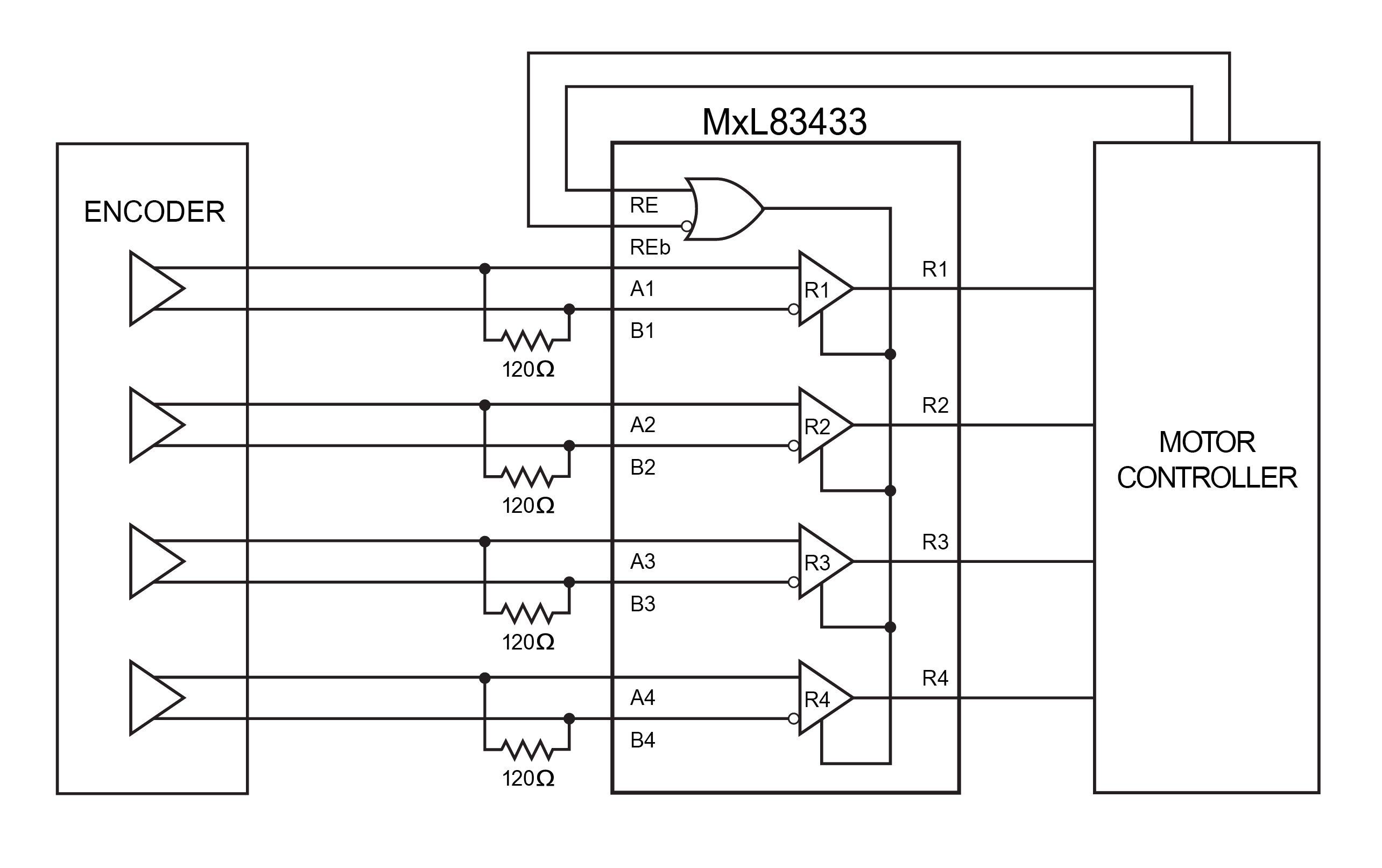
Consolidate Multi-Channel RS-485 / RS-422 Receive Functions
The MxL834xx family provides four RS-485 / RS-422 receiver channels in a single device for designs that need to monitor multiple differential links without integrated transmit capability. The architecture reduces component count while supporting industrial communication requirements such as wide common-mode operation, high receiver speeds, bus protection, and multi-node connectivity.
A range of speed, supply, and enable-control options allows the same receiver architecture to be applied across industrial control, motor feedback, communications, and other multi-channel interface designs. Designers can select the device that fits the required signaling rate and channel-control strategy while maintaining a consistent four-channel implementation.
- Upgrade speed without a respin: 10, 32, 65 and 80Mbps grades share one pinout within each enable style.
- Cover 3.3V and 5V rails: MxL83411 through MxL83436 operate from 3.0V to 5.5V. MxL83437 and MxL83438 run from 5V.
- Tolerate ground offsets: MxL83433 and above receive over ±15V common mode on a 4.5V to 5.5V supply, and bus pins withstand ±25V absolute maximum.
- Protect at the connector: A and B pins are rated up to ±12kV IEC 61000-4-2 contact, ±4kV IEC 61000-4-4 EFT and ±15kV HBM. MxL83433 through MxL83436 also list ±16kV air-gap.
- Keep channels aligned: MxL83435 and MxL83436 specify 2 ns maximum channel-to-channel skew, 4.5 ns part-to-part skew and 1 ns pulse skew.
- Reject bus noise: symmetrical thresholds preserve duty cycle, with 120 mV typical input hysteresis (70 mV on MxL83411).
- Load the bus lightly: 48 kΩ minimum input resistance is 1/4 unit load, allowing 128 receivers on one bus.
- Default to a known state: open-circuit inputs force the receiver output high.
- Insert on a live system: outputs stay glitch-free through power-up and power-down.
- Translate other signal levels: inputs accept RS-232, TTL, CMOS, LVTTL and LVCMOS single-ended signals and output TTL or LVTTL levels.
- Operate hot: all grades run from −40 °C to +125 °C, with −40 °C to +85 °C options on MxL83411, MxL83433 and MxL83434.
Driver timing sets the choice between the two parts. Values apply over −40 °C to +125 °C and VCC = 3.0V to 5.5V.
|
MxL83411
Quad RS-485 Receiver with IEC, ESD and EFT and Global Enable
Active

|
10 | - | 3.3, 5 | 8 | 2 | 4 | -40 to 85; -40 to 125 | Buy Now | Order Samples | MxL83411 datasheet | Quad RS-485 Receiver with IEC, ESD and EFT and Global Enable | RS-422, RS-485 | 0 | 4 | - | 15 | Standard | 128 | - | - | NSOIC-16, TSSOP-16 | - | - | - | - | ✔ | - | |
|
MxL83433
32Mbps Quad RS-485 Receiver with High IEC ESD/EFT and Global Enable
Active
|
32 | Global | 3.3, 5 | 12 | 4 | 7 | -40 to 85, -40 to 125 | Buy Now | Order Samples | MxL83433 datasheet | 32Mbps Quad RS-485 Receiver with High IEC ESD and EFT and Global Enable | RS-485, RS-422 | 0 | 4 | - | 15 | Standard | 128 | - | - | NSOIC-16, TSSOP-16 | - | - | - | - | ✔ | - | |
|
MxL83434
32Mbps Quad RS-485 Receiver with High IEC ESD/EFT and Paired Enable
Active
|
32 | Paired | 3.3, 5 | 12 | 4 | 7 | -40 to 85, -40 to 125 | Buy Now | Order Samples | MxL83434 datasheet | 32Mbps Quad RS-485 Receiver with High IEC ESD and EFT and Paired Enable | RS-485, RS-422 | 0 | 4 | - | 15 | Standard | 128 | - | - | NSOIC-16, TSSOP-16 | - | - | - | - | ✔ | - | |
|
MxL83435
65Mbps Quad RS-485/422 Receiver with High IEC ESD/EFT and Global Enable
Active
|
65 | Global | 3.3, 5 | 12 | 4 | 7 | -40 to 125 | Buy Now | Order Samples | MxL83435 datasheet | 65Mbps Quad RS-485/422 Receiver with High IEC ESD and EFT and Global Enable | RS-485, RS-422 | 0 | 4 | - | 15 | Standard | 128 | - | - | NSOIC-16, TSSOP-15 | - | - | - | - | ✔ | - | |
|
MxL83436
65Mbps Quad RS-485/422 Receiver with High IEC ESD/EFT and Paired Enable
Active
|
65 | Global | 3.3, 5 | 12 | 4 | 7 | -40 to 125 | Buy Now | Order Samples | MxL83436 datasheet | 65Mbps Quad RS-485/422 Receiver with High IEC ESD and EFT and Paired Enable | RS-485, RS-422 | 0 | 4 | - | 15 | Standard | 128 | - | - | NSOIC-16, TSSOP-15 | - | - | - | - | ✔ | - | |
|
MxL83437
80Mbps Quad RS-485/422 Receiver with High IEC ESD/EFT and Global Enable
Active
|
80 | Global | 5 | 12 | 4 | 7 | –40°C to 125°C | Buy Now | Order Samples | MxL83437 datasheet | 80Mbps Quad RS-485/422 Receiver with High IEC ESD and EFT and Global Enable | RS-485, RS-422 | 0 | 4 | - | 15 | Standard | 128 | - | - | NSOIC-16, TSSOP-16 | - | - | - | - | ✔ | - | |
|
MxL83438
80Mbps Quad RS-485/422 Receiver with High IEC ESD/EFT and Paired Enable
Active
|
80 | Paired | 5 | 12 | 4 | 7 | –40°C to 125°C | Buy Now | Order Samples | MxL83438 datasheet | 80Mbps Quad RS-485/422 Receiver with High IEC ESD and EFT and Paired Enable | RS-485, RS-422 | 0 | 4 | - | 15 | Standard | 128 | - | - | NSOIC-16, TSSOP-16 | - | - | - | - | ✔ | - |
No products match the selected filters.





Relevant Resources
Start with data rate and supply. MxL83411 covers 10Mbps legacy sockets, MxL83433 and MxL83434 reach 32Mbps, MxL83435 and MxL83436 reach 65Mbps with the tightest skew, and MxL83437 and MxL83438 reach 80Mbps on 5V. Then match the enable style and temperature grade.
Global-enable parts use an active-high RE on pin 4 and an active-low REb on pin 12, and either one enables all four channels. Paired-enable parts use active-high RE12 on pin 4 and RE34 on pin 12, each controlling two channels. Internal pulls default every enable to the disabled state, so tie unused enables to the active level.
No. MxL83433 through MxL83436 specify ±15V with a 4.5V to 5.5V supply and −7V to +12V from 3.0V to 5.5V. Over ±15V the input thresholds widen from ±200 mV to ±300 mV. MxL83411 specifies −7V to +12V at every supply.
Yes, if the bus can sit idle with all drivers off. The receivers guarantee a high output only for open inputs. On an idle terminated line, bias A at least 200 mV above B. See AN-291 for the difference between standard and advanced fail-safe.
Yes. Bias one input at VCC/2 with a 4.7 kΩ divider to receive TTL, CMOS, LVTTL or LVCMOS signals. A ±5.5V RS-232 output connects directly with B grounded at about 3Mbps, and a 3 kΩ / 2 kΩ divider handles ±15V signals up to 1.5Mbps.
No. Disabling the enables puts the outputs in high impedance, but the device keeps drawing supply current. The MxL83435 and MxL83436 data sheet lists 20 mW disabled versus 120 mW enabled at 5.5V and 65Mbps. Budget for this when replacing a receiver that has a shutdown pin.
Outputs swing to VCC, so a 3.3V supply gives LVTTL levels. Enable inputs use TTL thresholds of 2.0V minimum high and 0.8V maximum low. MxL83437 and MxL83438 run from 5V, so check that the MCU inputs are 5V tolerant or add translation. 1.8V logic always needs a level shifter.
For ESD and EFT up to the rated levels, often yes. The devices carry no IEC 61000-4-5 surge rating, so systems tested for surge still need external protection.
Up to 128. Each input presents at least 48 kΩ, which is 1/4 of a standard 12 kΩ unit load, and a standard driver supports 32 unit loads. Other loads on the bus reduce that count.
It depends on data rate, cable and termination. MaxLinear guidance for 24 AWG twisted pair gives about 50 ft at 10Mbps and about 4,000 ft at 90kbps, and higher rates need shorter runs. See AN-292 for design curves.
